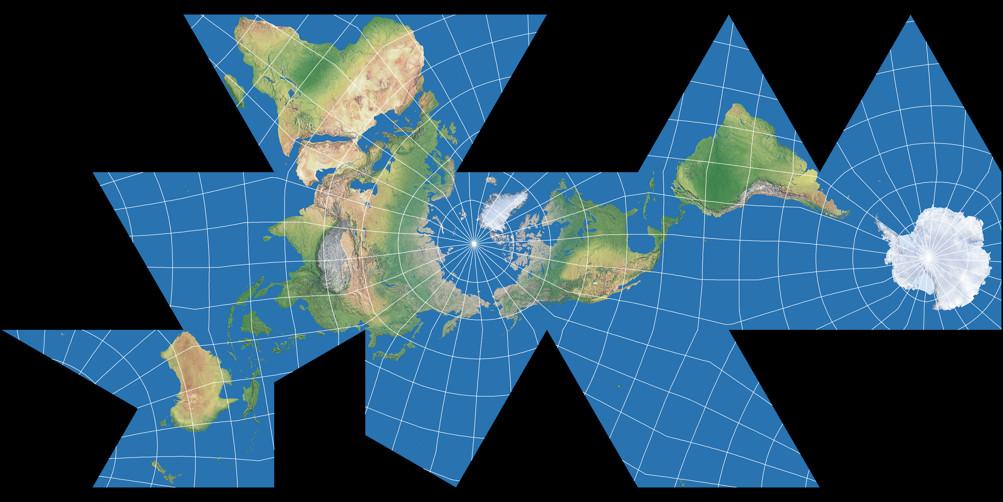
Image by Tobias Jung from Map Projections Licence: CC BY-SA
I was recently going through some old files on my computer and happened upon this following text. I wrote it when I was a struggling PhD student. I had read often that writing is a skill that needs to be practiced like a muscle. A good way to practice this muscle is to write regularly, no surprises there. An exercise often recommended is Freewriting - just write for a set time, without thinking much about it, and without stopping. Just write down whatever comes to mind. The advanced version is to pick a topic and keep writing about that. The idea is to leave the inner critic behind and just write, however nonsensical the result.
This is one of those results. I thought I might as well put it up here as the planned post is taking much longer to finish than expected. I have shortened it a bit but didn't change much else. Enjoy!
(Oh, if you're wondering about the picture - it's a Dymaxion Map)
Earth, so we are told in Douglas Adam’s “Hitchhiker’s Guide to the Galaxy” is nothing more than a supercomputer that was built to find the question to an answer another supercomputer had produced after eons of computing. That original computer, Deep Thought, was designed to find the answer to “life, the universe, and everything”. Its result - 42 - shows an effect we may often deal with during graduate studies. We do research, we work hard, analyse data etc, but in the end we have results that don’t make a lot of sense. Because we don’t know exactly what the question was.
In Douglas Adam’s universe, Deep Thought was at least able to help construct a new, even bigger computer (Earth) to compute the question to the answer it had found. Our results may not prove so cooperative. We are all alone in the quest for the question. A quest that might be desperate, because different aspects of the result answer different questions. Finding the one question that fits all our results might prove difficult and surpass the capabilities not only of grad students, but of the most accomplished professor.
Let me propose a solution to this dilemma. A method that might seem revolutionary: Try to put the cart before the horse. Turn around the process. Devise your question before you start to find answers. It can be a very short question. It can be a wh-question (one starting with a word like where, what, when, why or how), or a yes/no question, depending on your field and area of study. The former ones make for longer theses, while the latter ones usually involve a lengthy prove. Write your question on a piece of paper and stick it on the wall above your desk. Look at it every morning while the computer is starting up, and also glance at it from time to time while working. You want the question to be short enough to stick in your brain. And you will do all your work with that question in mind. No matter whether you collect your data, analyse it or crunch your numbers – it should all be done with the question on your wall and in your mind. Then, when you reach the exciting stage of seeing results, you will know what they mean. They will start to make sense.
Now if this approach does not sound all that revolutionary to you, I congratulate you. But I ask you not to judge others before you have actually written down that one question, and a thesis to answer it.
Earth would not exist if somebody had followed this piece of advice and fed Deep Thought with a proper question, and it would be a pity. But it is very unlikely that your thesis will create something as immense as a new planet if you don’t (at the very least because there is no funding for such projects in times as dire as these), so you can as well take the easier route and put the question first.